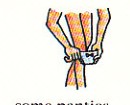
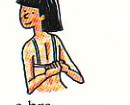
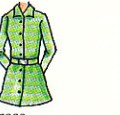
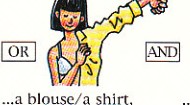
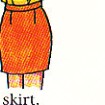
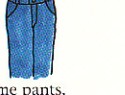
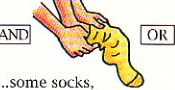
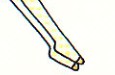
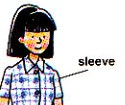
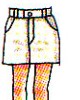
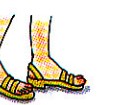
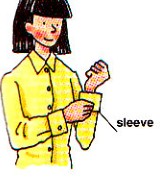
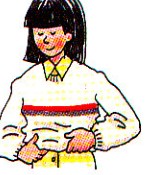
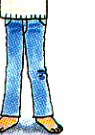
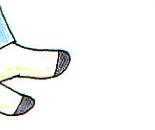
If it's cold, Pam wears heavy clothes: ...a long-sleeved shirt, ...a wool sweater, ...long pants, ...and thick wool socks.
...a long-sleeved shirt,
...a wool sweater,
...long pants.
...and thick wool socks.
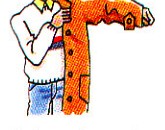
Before going outdoors, she puts on a heavy coat...
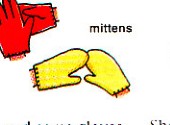
...and some gloves or mittens.
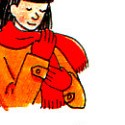
She wraps a scarf around her neck...
...and puts on a hat...
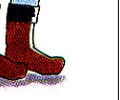
...and some boots.
Dressing this way keeps her warm.
Fabrics & Places
COTTON: a fabric that comes from the cotton plant
WOOL: a fabric that comes from a sheep
thin clothes (light, for hot weather)
thick clothes (heavy, for cold weather)
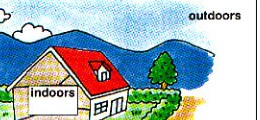
If something is outside a building, it is outdoors. If something is inside a building, it is indoors.
For Special Attention
wear= after you put on your clothes, you wear them — 穿上衣服之后,你就 wear(穿着)它们。
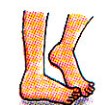
go barefoot= someone who goes barefoot walks around with no shoes or socks on his/her feet. His/Her feet are bare. — go barefoot 指走路时不穿鞋不穿袜,脚是赤裸的。
keep cool= if something keeps her cool, it helps her stay cool — 如果某事 keeps her cool,就是帮助她保持凉爽。
talk about the weather= 1. Use it + BE + an adjective: It's hot outside. 2. Use it + BE + the -ing form of a weather verb: It's raining. It's snowing. — 1. 用 it + BE + 形容词:天很热。2. 用 it + BE + 天气动词的 -ing 形式:下雨了。下雪了。
outdoors / indoors= if something is outside a building, it is outdoors. If something is inside a building, it is indoors. — 在建筑物外面就是 outdoors(户外);在建筑物里面就是 indoors(室内)。