Section 2: Getting Around

Unit 12: Taking a Bus

乘公共汽车

Simple Past in "Getting Around"

"Getting Around" uses mostly simple past verbs. Many of them end in -ed, but many others do not.
Examples:
• Mike walked to the store. [a "regular" verb]
• I took a bus to work. [an "irregular" verb]
Irregular past forms are listed in brackets [ ] in "Key Vocabulary."
Some time expressions with past-tense verbs:
• Yesterday
• Phrases with "last": last week, last month, last year, last Monday, etc.
• Phrases with "ago": two weeks ago, five days ago, a few minutes ago, a year ago

Taking a Bus

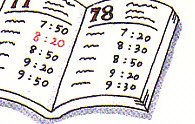
Jenny checking her bus schedule
Jenny checked her bus schedule.
the bus schedule showing the times
Her bus—a Number 77—was due at eight-twenty.
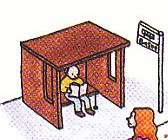
walking to the bus stop
She walked to the bus stop...
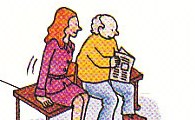
sitting on a bench waiting
...and sat on a bench to wait for the bus.
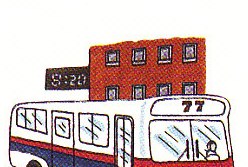
the bus arriving on time
The bus arrived on time (at eight-twenty).
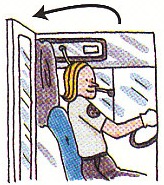
the driver opening the door
The driver opened the door...
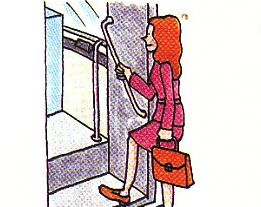
Jenny getting on the bus
...and Jenny got on the bus.
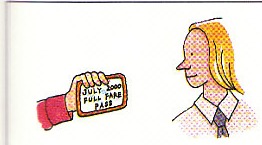
showing the driver her bus pass
She showed the driver her bus pass.
other passengers paying their fare
Other passengers paid their fare.
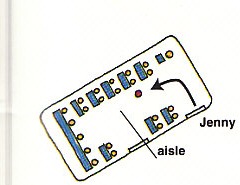
standing in the aisle
All the seats were full, so Jenny stood in the aisle.
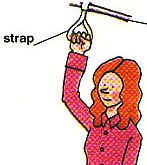
holding on to a strap
She held on to a strap on the overhead bars.
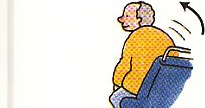
someone getting off, a seat empty
Soon, someone got off the bus, so a seat was empty.
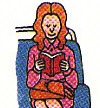
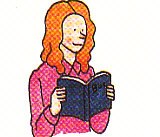
sitting down and reading a book
Jenny sat down and read a book while she rode the bus.
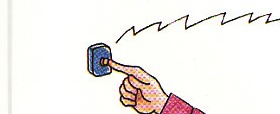
pressing the stop button
Near her stop, she pressed a button...
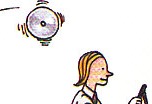
ringing the stop signal
...to ring the "stop" signal.
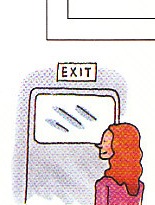
walking to the exit
She walked to the exit...
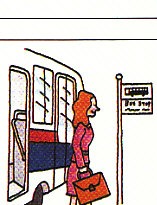
getting off at her stop
...and got off at her stop.

Paying Bus Fare

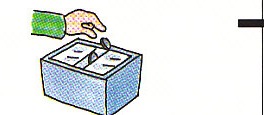
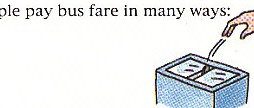
dropping money into a fare box
People pay bus fare in many ways: by dropping money into a fare box.
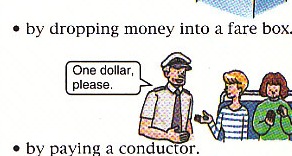
paying a conductor
by paying a conductor.
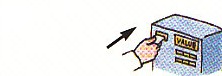
putting a fare card into a fare machine
by putting a fare card into a fare machine.
a receipt that says
Sometimes, the driver, conductor or machine gives a receipt.

For Special Attention

on time / late / early = if a bus is NOT on time, it is late or early — 公交车不准时的话,就是晚点(late)或提前(early)。
check the schedule = if Jenny checked her schedule, she looked at it for a short time to find some specific information — 珍妮查看时刻表,就是短时间地看一下,找她需要的具体信息。
bus pass = a bus pass is a card or a piece of paper. It means you can ride the bus without paying on the bus. It is good for a certain time (maybe one week, maybe one month, etc.). — 公交卡:是一张卡或一张纸;表示乘车时不必再付费;在一段时间内有效(也许一周,也许一个月等)。

Key Vocabulary

Verbs

单词音标中文
arrive/əraɪv/到达
check/ʧɛk/查看
drop/drɔp/投(币)
get [got] off/gɪt [gɑt] ɔf/下车
get [got] on/gɪt [gɑt] ɔn/上车
hold [held]/hoʊld [hɛld]/握住;抓住
open/ˈoʊpən/打开
pay [paid]/peɪ [peɪd]/付款
press/prɛs/按(按钮)
put [put] into/pʊt [pʊt] ˈɪntu/把…放入
read [read]/rɛd [rɛd]/阅读
ride [rode]/raɪd [roʊd]/乘坐
ring [rang]/rɪŋ [ræŋ]/按响(信号铃)
show/ʃoʊ/出示
sit [sat] down/sɪt [sæt] daʊn/坐下
stand [stood]/stænd [stʊd]/站立
wait/weɪt/等待

Nouns

单词音标中文
aisle/aɪəl/(车内)过道
bar/bɑr/横杆;扶手杆
bench/bɛnʧ/长椅
book/bʊk/
box/bɑks/箱(投币箱)
bus/bəs/公共汽车
button/ˈbətən/按钮
card/kɑrd/
conductor/kənˈdəktɚ/售票员
door/dɔr/
driver/ˈdraɪvɚ/司机
exit/ˈɛksət/出口
fare/fɛr/车费
machine/məˈʃin/机器(售票机)
money/ˈməni/
pass/pæs/乘车月票卡
passenger/ˈpæsənʤɚ/乘客
people/ˈpipəl/人们
receipt/rɪˈsit/收据
schedule/ˈskɛʤʊl/时刻表
seat/sit/座位
signal/ˈsɪgnəl/信号(下车信号)
stop/stɑp/车站
strap/stræp/吊环;拉带

Others

单词音标中文
due/du/预定应到的(形容词)
empty/ˈɛmti/空的(形容词)
full/fʊl/满的(形容词)
on time/ɔn taɪm/准时(状语短语)
other/ˈəðɚ/其他的(形容词)
overhead/ˈoʊvɚˈhɛd/头顶上方的(形容词)
soon/sun/很快;不久(副词)